.svg)

Giving employees access to Claude by Anthropic can happen quickly. Building the capability to use it well across different roles takes more deliberate planning.
A developer working with Claude Code, a marketing team using Claude for research and content, and an operations team handling document-heavy work will not need the same training. A common introduction can establish the basics, but it does not show each role how Claude fits into the work employees already own.
That is where enterprise Claude training needs to be practical. Employees need a way to learn the fundamentals independently, practice Claude against real tasks in their roles, and develop approaches that colleagues can repeat. Done over 90 days, that progression gives an organization a defined path from initial learning to broader Claude adoption.
What Should Enterprise Claude Training Accomplish in 90 Days?
The goal of a Claude training program should be practical capability, not simply course completion. By Day 90, employees should be able to identify tasks where Claude fits their role, apply it using approaches they have practiced, review the output appropriately, and repeat useful workflows without needing step-by-step assistance each time.
The organization should also have a clearer view of where employees can work independently, where additional Claude enablement would help, and which practices are ready to be shared with others. That makes the 90-day period useful as a capability-building cycle: establish a common baseline, apply Claude to role-specific work, and then turn successful individual practices into team capability.
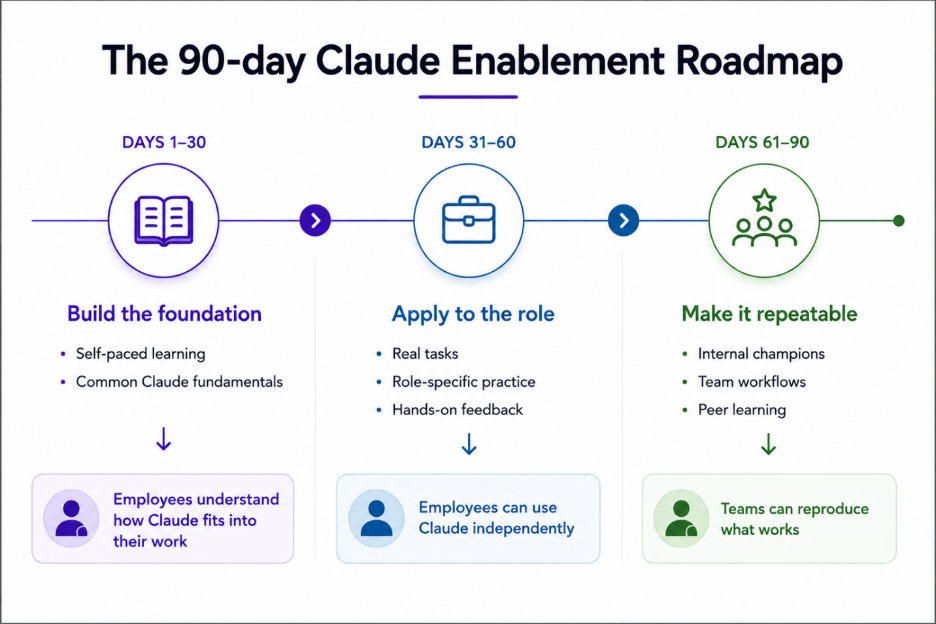
→ Days 1–30: Establish a Common Claude Foundation
The first month should give employees the baseline they need before training becomes specific to their roles. A self-paced Claude training track can cover Claude fundamentals, effective interaction, relevant use cases, and the organization's expectations for using Claude at work. Employees can work through this material alongside their existing responsibilities rather than waiting for every participant to attend the same session.
The baseline should also account for how different teams are already working with Claude. Looking at the work patterns and workflows where Claude is already being used across teams can help identify where training needs to go deeper and which roles require different learning paths. By the end of this stage, employees should understand where Claude fits into their work and what they need to practice next.
→ Days 31–60: Make Claude Training Specific to the Work
Once employees have a common foundation, training should move closer to the work itself. This is where role-based Claude training becomes more useful than another general product demonstration. Start with a task the employee already performs. Map how the task is handled today, identify where Claude can contribute, establish where human review remains necessary, and practice the workflow using realistic examples.
A marketing team could work through campaign research, source synthesis, drafting, and review. An operations team could work through a recurring document process. A development team could use a representative coding task to determine where Claude Code fits within its existing development and review practices.
The training should leave employees with something they can use again. A useful test is whether the employee can perform the task independently after the training session. If they can, the program has built practical capability rather than familiarity with features.
This is where role-specific learning paths and hands-on Claude enablement can support the next level of capability. Training can be shaped around the roles, workflows, and skill gaps identified during the first month instead of putting every employee through the same curriculum.
→ Days 61–90: Turn Individual Capability Into Team Capability
By the third month, some employees will have developed approaches that others in the same role can learn from. These employees can act as internal champions, demonstrating how they use Claude on recurring work, helping colleagues adapt those approaches, and identifying questions that indicate where further training is needed.
Team sessions can then focus on repeatable Claude use cases rather than another introduction to the technology. An operations team might work through the same document process with several employees and compare approaches. A marketing team could refine a research-and-drafting workflow so others can reproduce it. A development team could establish a consistent approach for using Claude Code within a particular stage of development.
The focus is now on making useful practices transferable. Employees apply Claude to real tasks, refine those approaches with colleagues, and turn the workflows that work into practices others can use.By Day 90, teams should have examples they can demonstrate, repeat, and improve without relying entirely on external instruction.
How Do You Know Whether Claude Training Is Working?
Training completion tells you who finished the program. It does not tell you whether Claude adoption is becoming part of how employees actually work. A stronger Claude adoption program review looks at whether employees can apply what they learned in the work for which they were trained.
Useful indicators include:
- Employees applying Claude to tasks covered during training
- Employees repeating those tasks without facilitator support
- More than one person using the same practical approach
- Internal champions helping colleagues adopt proven techniques
- Teams identifying workflows that need further development
This gives leaders a more useful view of capability than completion rates alone. It shows where training has translated into independent use and where another level of support is warranted.
Where Should Claude Enablement Go After the First 90 Days?
The most useful outcome of a 90-day Claude training program is knowing where teams are ready to go further. If employees have built confidence but need more role-specific depth, the next investment should strengthen those capabilities. If teams have developed repeatable practices, those approaches can be extended across roles and teams. And when a team has identified a workflow that needs deeper technical development, it may be time to bring hands-on expertise into a team’s priority Claude workflow and help develop it further. That gives leaders a practical way to decide what comes next without putting every team down the same path.
NewRocket can help teams take the next step based on what they have already demonstrated. That mean deepening role-based skills, scaling proven practices, or bringing hands-on expertise into workflows that need further development. The approach can be tailored to each organization’s specific needs, workflows, and level of Claude maturity, so the next step reflects where each team is ready to go.


.png)
.png)
.png)
.png)

.png)
.png)
.png)
.png)
.png)
.png)
.png)
.png)
.png)
.png)
.png)
.png)