.svg)

As Claude adoption expands across enterprise teams, workflows, and products, Claude token usage can change for many reasons. More employees may be using Claude, teams may be applying it to more complex work, or workflows such as Claude Code and Cowork may become part of day-to-day operations.
For enterprise teams, a change in consumption does not explain itself. Leaders need to understand what is driving it, where usage is concentrated, whether the capability being used fits the work, and how to manage consumption without limiting valuable adoption.
That is where Claude cost optimization needs to go beyond individual token-saving tactics. The goal is to make Claude token consumption more intentional and aligned with valuable work as adoption scales.
Why Is Claude Consumption Increasing?
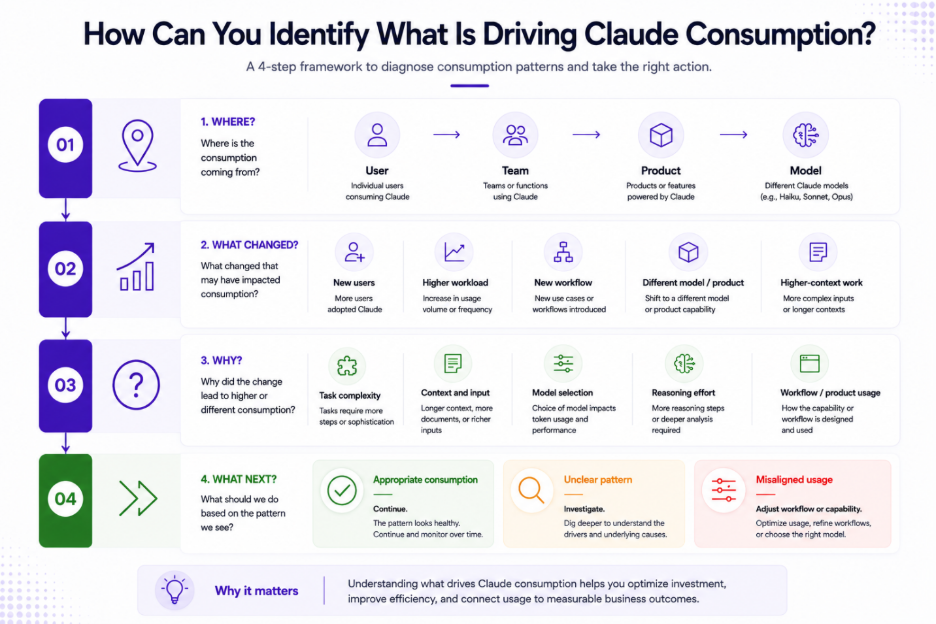
Before deciding how to manage consumption, teams need to understand what can cause it to change. The amount of Claude processing required can vary with the work being performed, the information Claude receives, the capability selected, the reasoning effort applied, and the workflow in which Claude is being used.
- Task Complexity
A routine request and a complex analysis can require very different levels of processing. Coding, research, and other demanding workflows can also involve more extensive interactions than straightforward tasks. This matters when comparing Claude token usage across teams or users. A team handling complex workflows may reasonably consume more than a team using Claude for simpler work, so consumption needs to be considered alongside the type of work being performed.
- Context and Input
The information Claude processes can also influence consumption. Long conversations, large amounts of input information, repeated context, and information that is no longer relevant can all affect how much information a workflow processes. The objective is not to reduce context indiscriminately. It is to understand whether the information being processed contributes to the task or is simply being carried forward without a clear purpose.
- Model Selection
Different tasks can require different levels of capability. Routine work, research, coding, and complex analysis can have different requirements for reasoning and accuracy. Claude Model selection should therefore reflect what the work requires rather than applying the same approach across every task.
- Reasoning Effort
The level of reasoning applied can vary with the work. A complex analysis may justify greater effort, while a straightforward task may require less. Effort level should be considered alongside task complexity and the importance of the outcome.
- Workflow and Product Usage
Different Claude workflows can produce different consumption patterns. Claude Code and Cowork support more involved workflows than straightforward conversational interaction, so usage can reflect the additional context, tools, and steps involved in completing a task. As teams adopt these workflows, Claude token consumption can change even when the number of users remains relatively stable.
How Can You See Where Claude Usage Is Going?
Understanding what can drive consumption tells teams why usage may change. The next step is determining where that change is occurring. Rather than looking at a single spend figure, enterprise teams can use Claude usage analytics to examine consumption by user, team, product, model, and usage trend. This provides a more granular view of where Claude token consumption is concentrated and what may be driving the change.
→ Claude Usage by User, Team, and Product
A total spend figure shows how much has been consumed, but it does not show where that consumption is coming from.Looking at usage by user and team can distinguish broad adoption from concentrated usage. A rise spread across multiple teams may reflect wider adoption, while a similar increase concentrated among a small group of users may point to specific workflows that deserve closer examination. Product-level visibility adds another layer. If Claude Code or Cowork adoption increases, for example, the organization can distinguish a change in product usage from a broader increase across conversational Claude use.
→ Claude Spend by Model
Model-level visibility helps teams understand which capabilities account for consumption.That information becomes more useful when viewed alongside the work being performed. A change in model-level usage may reflect a shift in task complexity, a change in workflow, or a different capability being applied to existing work. The purpose of this analysis is not to assume that one model is inherently preferable. It is to understand how model usage contributes to the organization's overall consumption.
Identifying High Claude Consumption
High consumption is a starting point for investigation, not a conclusion. A user or team may consume more because they handle complex work, support an important workflow, use Claude extensively as part of their role, or have adopted Claude for new types of work.
Patterns worth reviewing include:
- Rapid increases in consumption
- Significant differences between similar teams
- Concentrated usage among a small group of users
- Repeated high-context workflows
- Changes in consumption following adoption of a new product or workflow
- Usage that appears out of proportion to the requirements of the work
The useful question is what is behind the pattern and whether the consumption is appropriate for the work being performed.
How Can Enterprises Manage Claude Usage Without Restricting Adoption?
Choosing the appropriate capability addresses one part of Claude usage optimization. At enterprise scale, teams also need consistent usage practices, user education, and controls that support adoption without treating lower consumption as the only objective.
→ Set Usage Expectations by Role and Workflow
Enterprise adoption of Claude can vary by role, team, workflow, AI maturity, business requirements, and the type of work being performed. A team using Claude for complex coding workflows can have a very different consumption profile from a team using it for routine knowledge work. Usage expectations should account for those differences rather than applying one consumption standard across the organization.
→ Give Users Practical Guidance
User education can address the behaviors that influence consumption without turning cost management into a restriction exercise.
Useful guidance can cover:
- Choosing capability based on task requirements
- Using context that contributes to the task
- Applying reasoning effort appropriate to the work
- Recognizing recurring usage patterns
- Understanding when a workflow may warrant review
The objective is to give employees enough context to make informed decisions as their use of Claude adoption expands.
→ Apply Controls Where They Solve a Specific Need
Enterprise controls can provide appropriate boundaries as adoption scales. Depending on the organization's requirements, these may include:
- User-level limits
- Group-level controls
- Role-based access
- Spend limits
- Usage monitoring
The control should correspond to the need being addressed. A blanket restriction can limit productive use without explaining or addressing what is driving consumption.
→ Build a Claude Consumption Policy
A practical enterprise policy should establish:
- Who owns Claude spend management
- Which usage metrics should be monitored
- How users and teams are evaluated
- When controls apply
- How high-consumption patterns are reviewed
- How often consumption is assessed
- How consumption connects to value
This creates a consistent operating approach as Claude adoption expands across the organization.
How Do You Know Claude Cost Optimization Is Working?
Managing consumption provides a way to control and understand spending. It does not establish whether the organization is getting value from its Claude investment.
Token Optimization vs. Cost Optimization
Token optimization focuses on reducing unnecessary consumption. And Cost optimization is all about making spending appropriate, predictable, and explainable.
Reducing tokens can contribute to claude cost optimization, but lower consumption alone does not establish that optimization has been achieved. A workflow that consumes more Claude may still be the better outcome if it supports more valuable work, improves productivity, or replaces a more costly process. Once consumption and cost are visible, organizations can evaluate them alongside measures that show what the investment is enabling.
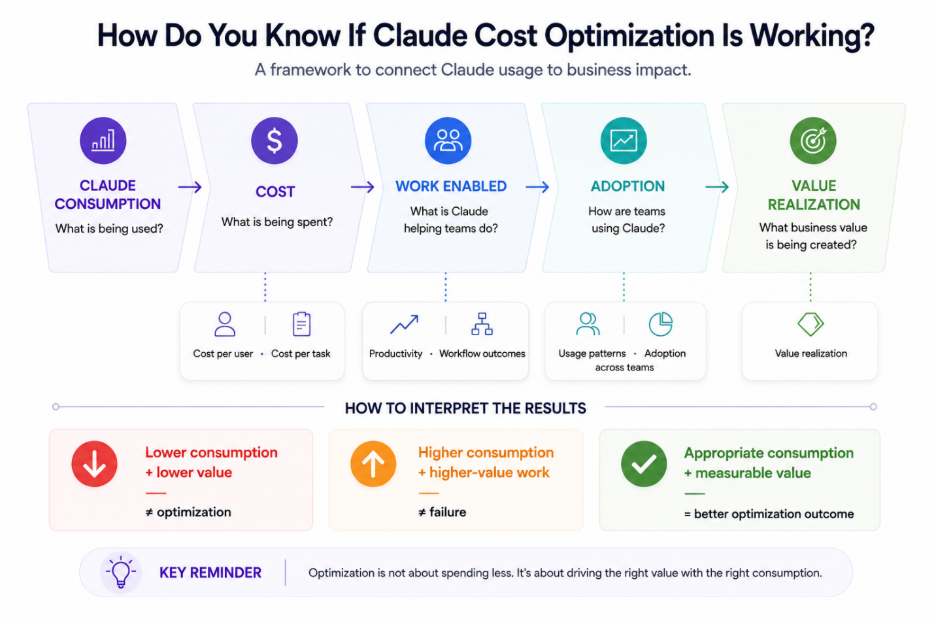
The objective is appropriate consumption for the work being performed. That means a useful optimization decision considers three things together:
- What is being consumed
- what is being spent
- what value is being created
This is where Claude cost management becomes part of a broader adoption discipline rather than a narrow exercise in reducing tokens.
Conclusion
As Claude adoption expands, enterprise teams need more than tactics for reducing token consumption. They need visibility into where usage is occurring, a way to match capability to the work, practical governance for scaling adoption, and measures that connect consumption to business value.
Making those practices work across an organization also depends on how teams are enabled to use Claude in the context of their own work. A department-by-department approach can give teams guidance relevant to their workflows. For organizations building that capability, Claude training and enablement can provide role-specific guidance for teams with different workflows and levels of experience. This can help organizations move from individual Claude use toward broader enterprise adoption of Claude, with enablement aligned to how different teams actually work.


.png)
.png)
.png)
.png)

.png)
.png)
.png)
.png)
.png)
.png)
.png)
.png)
.png)
.png)
.png)
.png)