.svg)

For financial institutions, maintaining a balance between discovering vulnerabilities and remediating them at the pace they are identified is becoming increasingly important. That balance was already difficult to hold.
Following Anthropic's Mythos announcement, the question has sharpened considerably: if AI is becoming smarter at surfacing vulnerabilities, how fast can organizations close the gaps before they are exploited? As detection becomes more effective, organizations may soon find vulnerabilities faster than they can realistically remediate them. In many ways, this has surfaced a reality security leaders have been carrying for years: Finding the vulnerability is only half the battle. The harder challenge is executing a coordinated vulnerability response consistently across complex environments before risk exposure compounds.
.png)
If your team is already managing thousands of findings, what happens when discovery volume increases again? That question sits at the center of this eBook.
The Coordination Challenge in Vulnerability Response
With thousands of applications, legacy systems, and complex integrations operating under strict regulatory requirements, a simple patch can accidentally impact another critical system. As organizations scale, the challenge becomes less about identifying vulnerabilities and more about executing a repeatable vulnerability response process across increasingly complex environments.
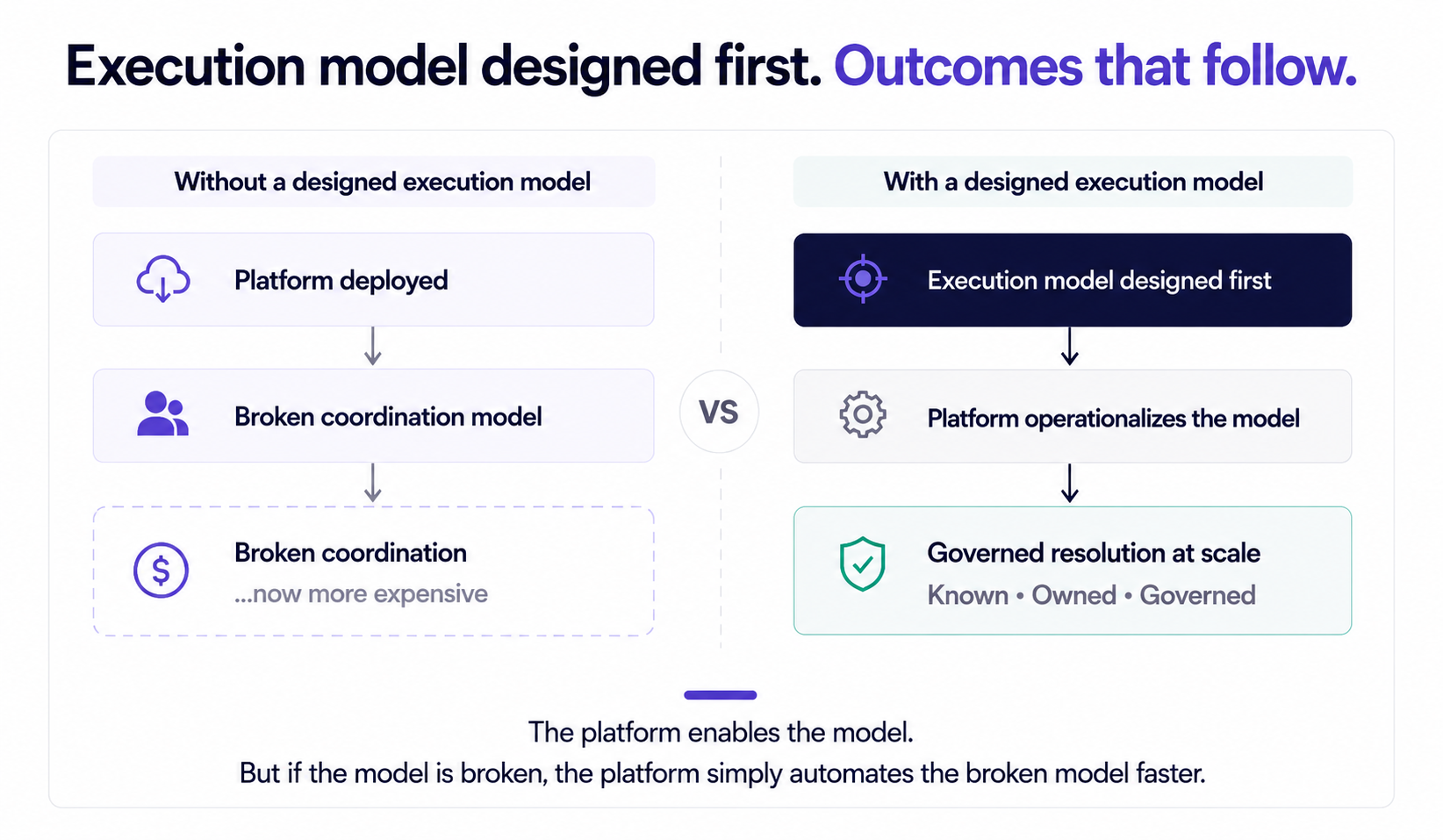
Most organizations discover that the challenge is not a lack of tools, it’s the fragmented lifecycle because of the multiple tools. This creates not only the challenge of building a vulnerability management program that can consistently route, prioritize, govern, and execute remediation activities across teams, but also drive audit traceability and continuous monitoring. Many invest in SecOps and IRM platforms expecting coordination to improve. Yet most still struggle to reduce backlogs because technology-based milestones alone do not resolve ownership, workflow, and governance challenges.
Three Operational Foundations of Effective Vulnerability Response
Across remediation transformation projects in financial services environments, certain patterns consistently separate organizations that reduce exposure from those that accumulate findings. Three operational foundations appear repeatedly in programs that close the gap.
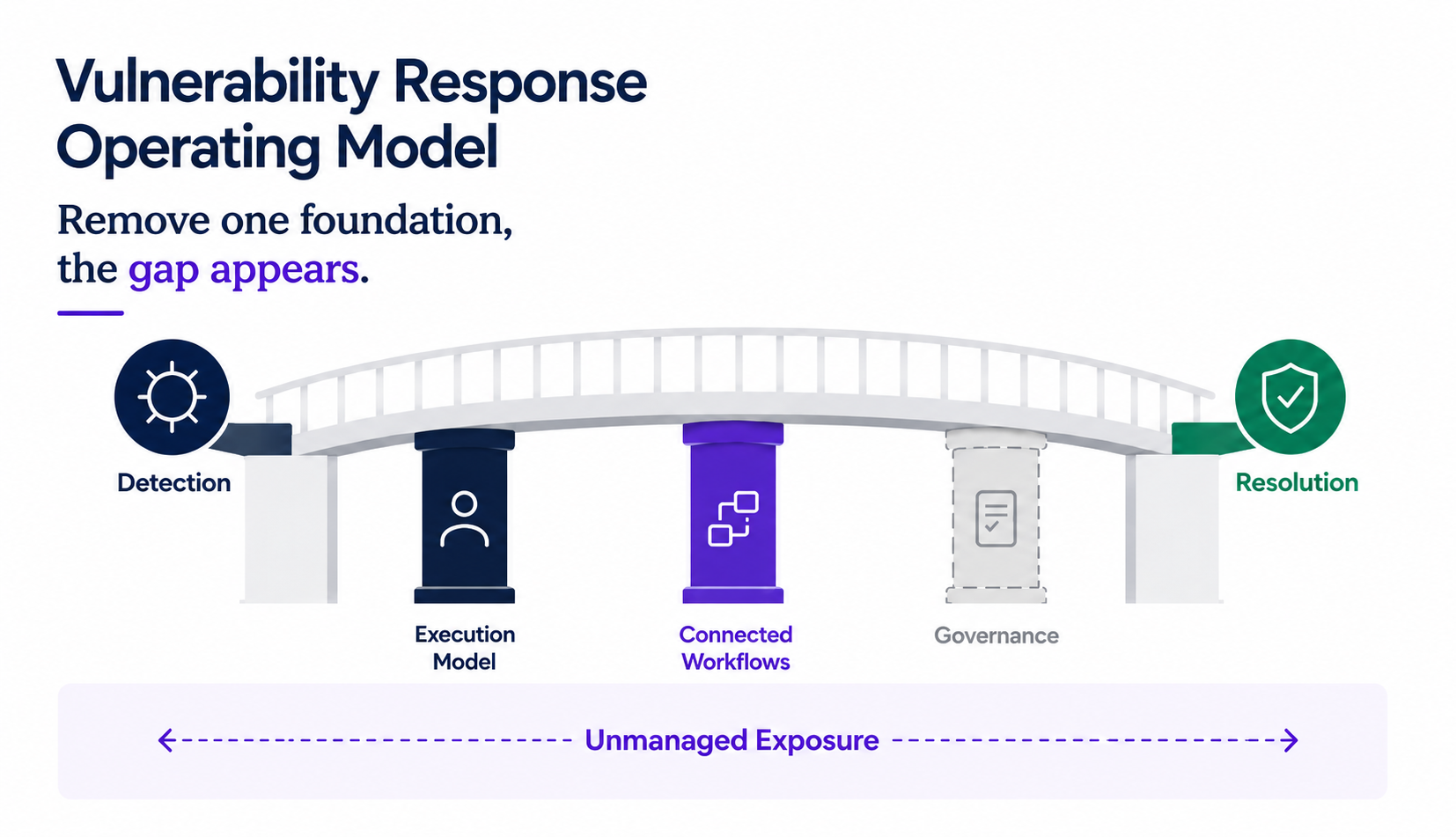
Every stage in a connected remediation workflow feeds the next. When one breaks, everything downstream inherits the problem. And when workflows are structured correctly, accountability is embedded, governance stops being a separate reporting exercise, it becomes a continuous record produced by operations itself.
Who Needs a More Effective Vulnerability Response Model?
Anyone who sits in the uncomfortable middle will recognize it immediately. The person responsible for fixing things while navigating coordination problems, ownership confusion, growing backlogs, and governance pressure.
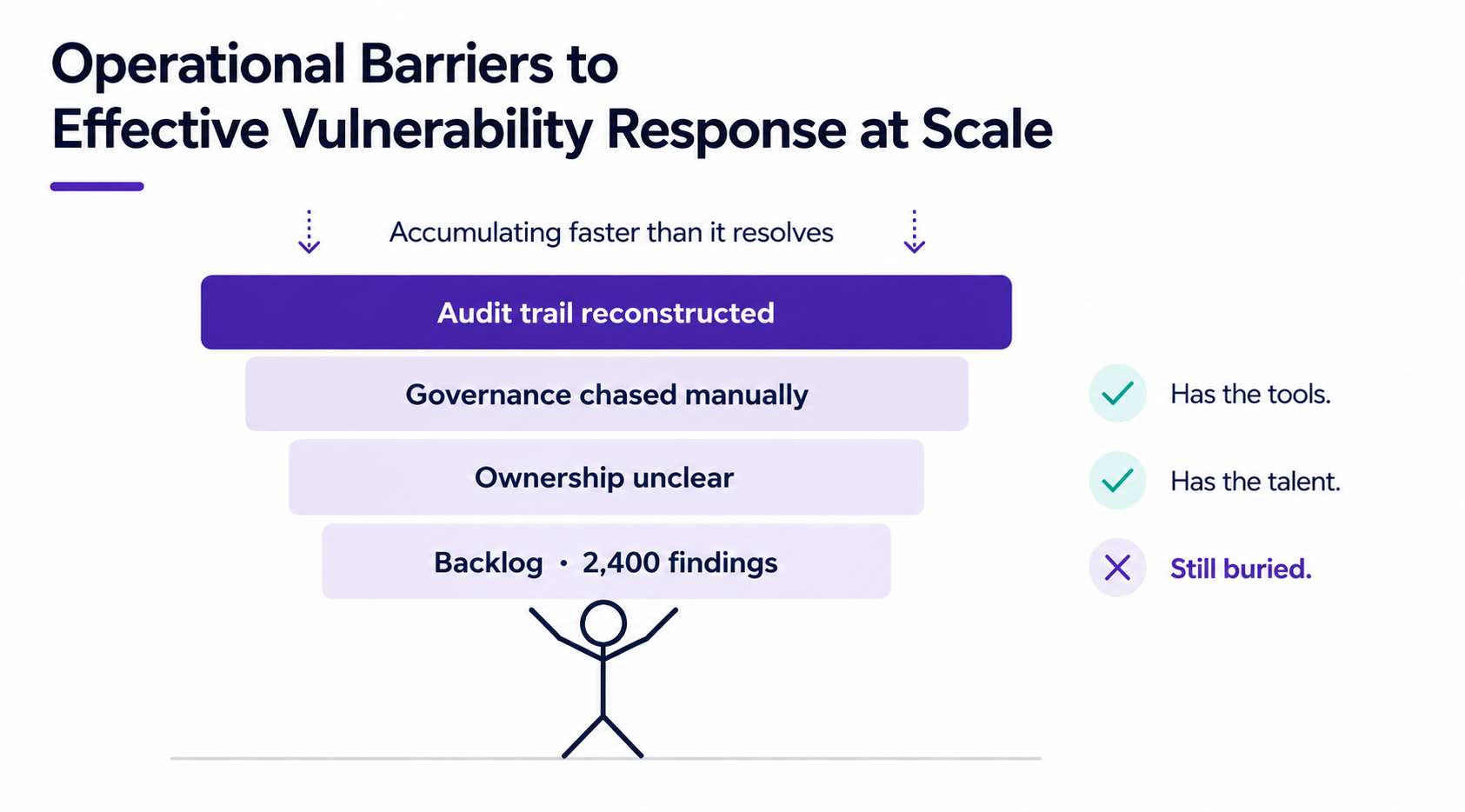
Security operations leaders, IT directors, risk and compliance heads at financial institutions who have the tools, the talent, yet still watching the backlog grow.
The clearest signal is this: what leadership sees and what is operationally happening are two different pictures. The dashboard shows progress. Yet the vulnerability backlog continues to grow. The result is a widening gap between reported progress and operational reality. Built from remediation transformation experience across financial services environments, this eBook explores the operational foundations necessary to strengthen vulnerability response at scale. It provides practical guidance on building a scalable vulnerability response model, improving governance, reducing vulnerability backlog, and accelerating remediation execution from detection to resolution.


.png)
.png)
.png)
.png)

.png)
.png)
.png)
.png)
.png)
.png)
.png)
.png)
.png)
.png)
.png)
.png)