.svg)

Artificial intelligence is becoming part of everyday operations across financial services. AI models support credit decisions, algorithmic trading systems execute transactions in milliseconds, and customer-facing AI is changing how institutions interact with customers. As AI becomes embedded in critical banking operations, governance becomes just as important as technology itself.
The challenge is ensuring your organization can explain AI-driven decisions, demonstrate appropriate oversight, and respond effectively when something goes wrong. When AI influences lending decisions, fraud detection, trading activity, or customer interactions, accountability remains with the institution.
Financial services have already seen the consequences when governance cannot keep pace with AI. For leaders responsible for AI Governance in Financial Services, the question is whether your organization has visibility into AI, governance controls, accountability, and oversight needed to identify issues before regulators, customers, or the business are affected.
The Growing Gap Between AI Adoption and Governance
Financial institutions already operate mature governance processes across operational risk, cybersecurity, compliance, and data management. AI introduces a different operating reality because production models continue to evolve after deployment.
Customer behavior changes. Fraud techniques evolve. Large language models can generate different responses to similar prompts. As AI becomes embedded in business-critical processes, AI model governance extends beyond validation to ongoing oversight, continuous monitoring, human oversight, and decision transparency.
Regulatory expectations reinforce the same principle. AI-driven decisions must be explainable. Human oversight is expected where decisions have significant customer or regulatory impact. Institutions must also demonstrate accountability when regulators ask how automated decisions were reached. Together, these principles form the foundation of an effective AI governance framework that supports Responsible AI and regulatory compliance.
The Pattern
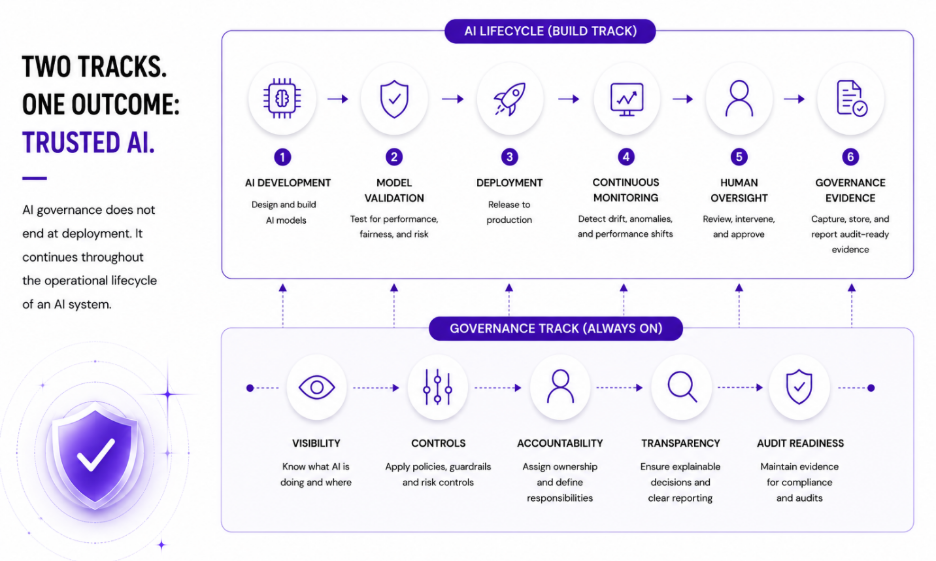
Deploying an AI model is only one stage of its lifecycle. As AI scales across the business, point-in-time reviews are no longer enough. Governance must become continuous through ongoing monitoring, oversight, and accountability,
How AI Governance Gaps Become Business Risks Across Financial Services
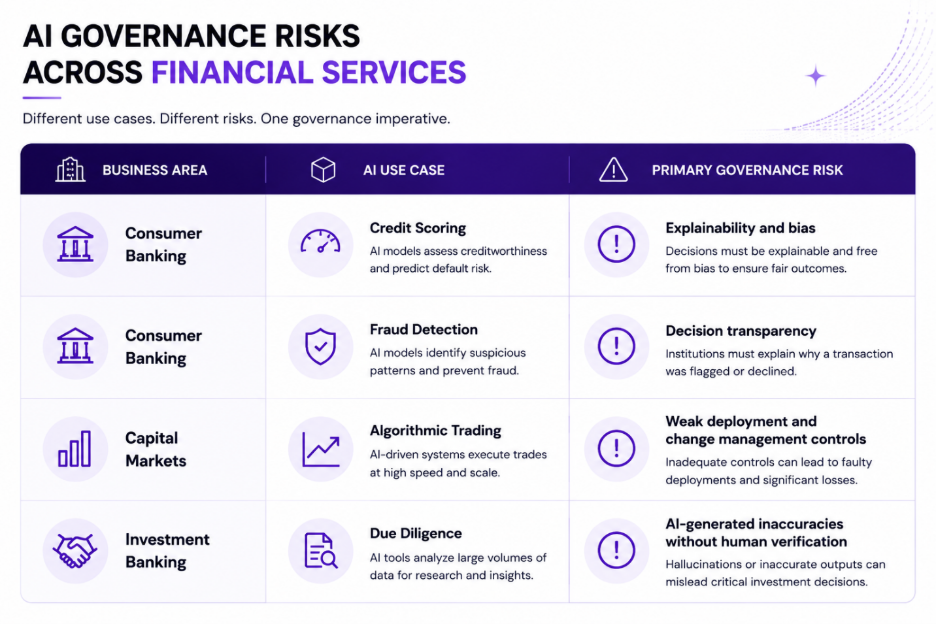
The governance challenge looks different across business functions, but the underlying issue remains the same. AI often performs as intended. The governance layer determines whether institutions can explain decisions, demonstrate appropriate oversight, and identify accountability when questions arise.
1. Consumer Banking - Credit
AI-driven credit models evaluate hundreds of variables to determine creditworthiness and predict default risk. Some of those variables can act as proxies for protected characteristics, producing discriminatory outcomes even when protected attributes are never explicitly used.
In a high-profile consumer credit investigation, customers reported receiving significantly different credit limits despite having similar financial profiles. Regulators focused on whether the institution could explain how automated decisions were made. The inability to provide meaningful explanations became a governance issue rather than simply a model issue.
2. Consumer Banking - Fraud Detection
Models trained on historical fraud patterns can develop blind spots incorrectly flagging legitimate transactions while missing new fraud techniques. Approving fraudulent transactions affects customer trust, and when an institution cannot explain why that decision was made, model risk management becomes both a regulatory and operational concern.
3. Capital Markets – Algorithmic Trading
In capital markets, governance failures can become operational failures within minutes. Algorithmic trading systems operate at machine speed, leaving little opportunity for manual intervention once trading begins.
Industry observations have shown that software deployment errors, insufficient testing, and weak change management controls can trigger unintended trading activity, leading to significant financial losses within a very short period. In many cases, the technology performed as designed. The breakdown occurred in the governance processes surrounding deployment, oversight, and operational controls.
The Pattern
" Every example shares the same underlying theme. AI and automation can perform as designed. Without effective governance, organizations may struggle to prevent, detect, and respond to issues before they become operational or regulatory events."
4. Investment Banking
The governance challenge extends beyond lending and trading. Investment banking introduces a different set of considerations as large language models become part of due diligence, research, financial analysis, and client deliverables.
The concern is not how quickly information can be produced. It is whether that information remains accurate, confidential, and suitable for client use. AI-generated content that includes inaccurate analysis, fabricated references, or unsupported conclusions creates governance and regulatory risks when incorporated into client-facing work.
Across financial services, organizations have observed that AI-generated content requires robust governance before it can be used in customer-facing or business-critical deliverables. As a result, many financial institutions have strengthened governance by introducing human review, source verification, and approval workflows to help ensure accuracy, transparency, and accountability. Regardless of how content is created, responsibility for AI-assisted decisions remains with the institution.
An AI Governance Framework for Responsible AI
What connects these findings in consumer lending, fraud detection, capital markets, and investment banking is not the technology itself. It is the governance layer that determines whether AI-driven decisions remain transparent, accountable, and subject to appropriate oversight.
That governance layer combines policies, controls, accountability, and oversight to help institutions understand where AI is being used, catch issues early, and respond before they become operational or regulatory risks. For high-impact business decisions, governance extends well beyond deployment: continuous monitoring, meaningful human oversight, and regular review help ensure production AI continues to operate as intended while remaining aligned with business objectives, AI accountability, and regulatory expectations.
Strengthen AI Governance as AI Adoption Grows
For organizations, it is critical to ensure governance keeps pace as AI becomes embedded across lending, fraud detection, trading, client advisory services, and other business-critical processes. That means demonstrating explainability, maintaining appropriate human oversight, and producing evidence when AI-driven decisions are challenged by regulators, customers, or internal stakeholders.

Governance conversations are most effective when they begin with the business process rather than the technology. Each AI use case introduces different governance considerations and levels of risk. Strengthening governance around those business processes helps supports responsible AI, improve AI Risk Management, and maintain confidence in AI-driven decisions as adoption continues to expand across financial services.
AI Governance in Practice
Policies and periodic reviews provide the foundation for governance, but they are only the beginning. As AI becomes embedded in business-critical processes, governance must extend beyond documentation and oversight into day-to-day operations. Financial institutions need a practical way to operate AI at scale by connecting visibility, accountability, human oversight, and governance controls across the AI lifecycle.


.png)
.png)
.png)
.png)

.png)
.png)
.png)
.png)
.png)
.png)
.png)
.png)
.png)
.png)
.png)
.png)