.svg)

There’s no question that ServiceNow technical debt exists in most mature implementations. It builds over time through decisions made to solve immediate needs, each one reasonable in isolation and rarely revisited in a broader context. As platforms evolve, the focus stays on what needs to change next versus what should be reconsidered from the past.
So the question is not "does debt exist", but what is the business impact of ServiceNow technical debt, what that debt is costing you, and where it actively works against your current goals.
The impact of that debt usually shows up in four related areas: the velocity of change, maintenance effort, adoption, and modernization cost.
The Hidden Costs Are More Connected Than They Appear
These costs usually add up slowly because they are easy to explain away as isolated decisions. Taken together, they reveal how ServiceNow technical debt is shaping outcomes across the platform.
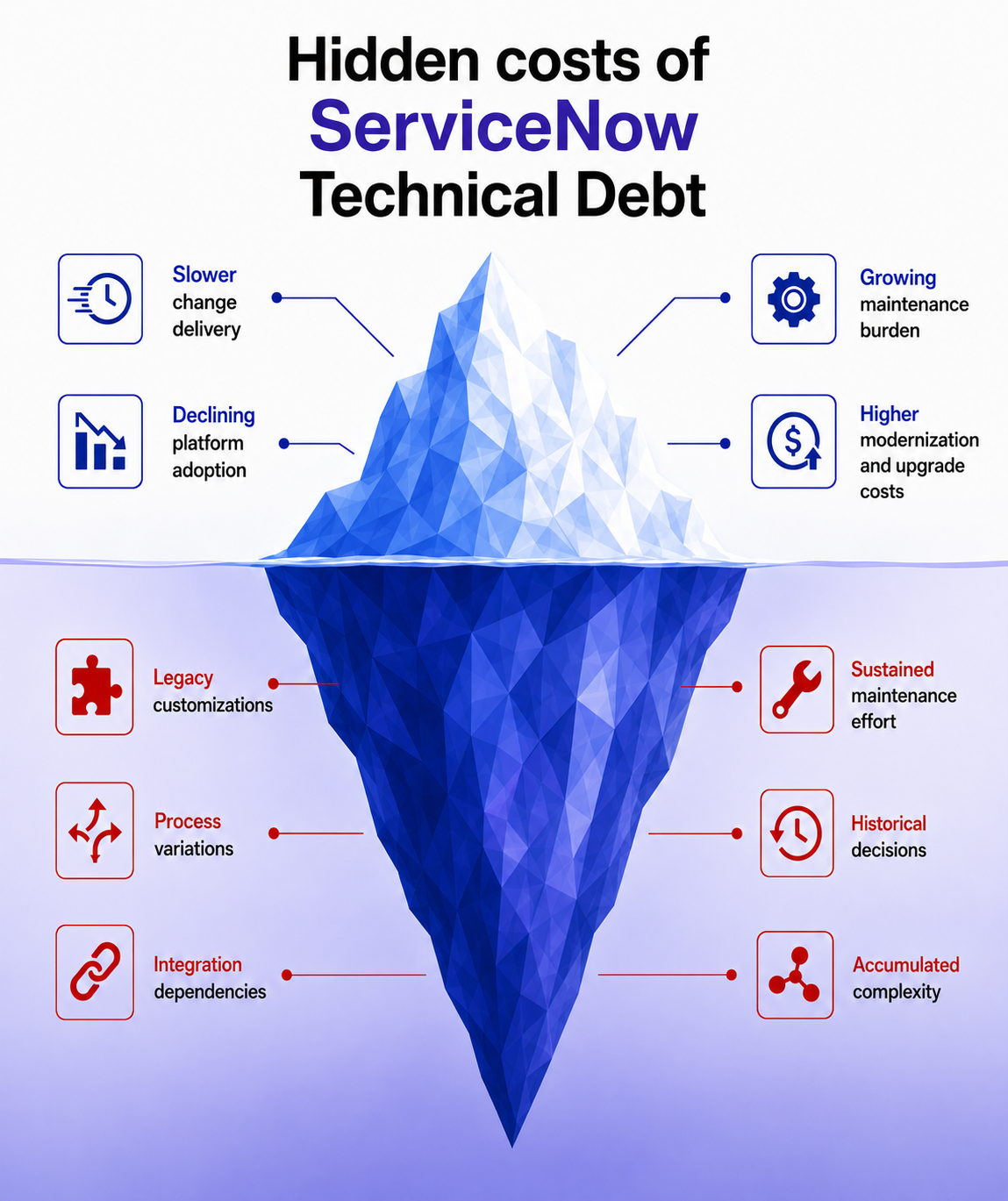
Cost 1: Slower Change Delivery
Why do ServiceNow changes take longer when there is no single, obvious issue? Usually because every change sits inside a more tangled environment than it did a year ago. A workflow update turns into a dependency review. The review adds testing, which adds approvals. Each step introduces effort. Together, they slow delivery and push business work further out.
That is why ServiceNow changes take longer. The real cost is not the extra effort on one release. It is the work that does not happen because the team is tied up validating old dependencies and supporting outdated customizations. Change velocity is a business issue. It affects how quickly the organization can respond to new priorities, and ServiceNow technical debt sets the pace.
Cost 2: Declining Platform Adoption
Most technical debt begins with a reasonable decision: a process adjustment, an added approval, a targeted customization. Each decision makes sense at the time.
The impact appears gradually. The platform begins to reflect years of accumulated compromises rather than enabling people to do their best work. Employees lose confidence in the product. Compliance becomes inconsistent, and reliance on workarounds increases.
Adoption suffers when using ServiceNow becomes a burden. People turn to workarounds because they are easier than the process in front of them. ServiceNow technical debt rarely serves the customer in the long term because the capabilities designed to improve work lose their impact when people hesitate to use them.
Cost 3: Growing Maintenance Burden
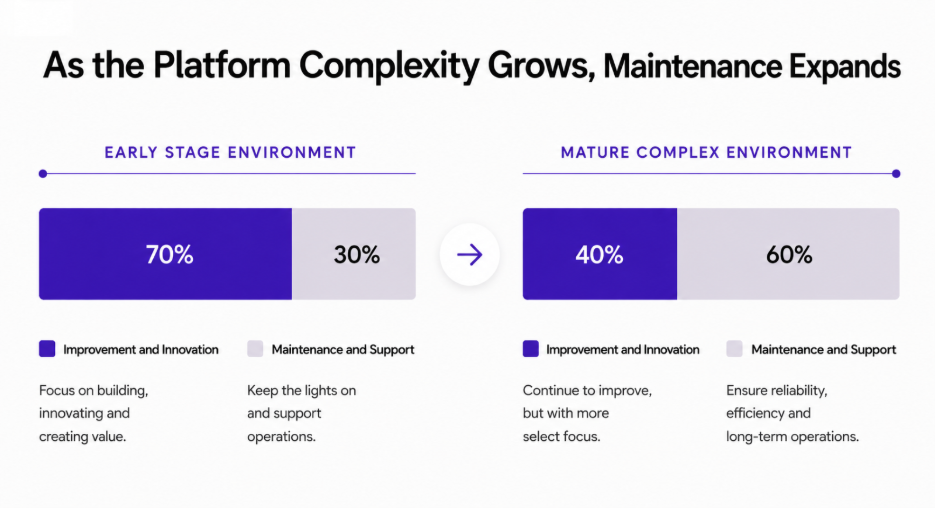
Technical debt changes how platform teams spend their time. The issue is not whether maintenance exists; every ServiceNow environment requires ongoing support. The problem emerges when responsibilities tied to past decisions continue expanding long after the original business need has changed.
Customizations become permanent obligations. Integrations require monitoring. Process variations remain in place because removing them introduces risk. Over time, the team inherits an increasing number of commitments that everyone is expected to sustain but may no longer actively serve the business.
Capacity gets absorbed by preserving the environment exactly as it is, leaving less time to improve the platform and less capacity for effective ServiceNow platform management. The work continues because the platform depends on it, even when the business case behind it no longer does.
Cost 4: Higher Modernization and Upgrade Costs
ServiceNow modernization inherits the environment that already exists. Whether the goal is AI adoption, process transformation, or platform consolidation, teams cannot move directly to the future state they envision. They first have to account for the complexity already built into the platform.
The impact of technical debt on ServiceNow upgrades becomes visible in the work required to deliver the initiative. Budget intended for new capabilities shifts toward remediation. Teams spend time identifying what can be retained, what needs to be redesigned, and what must be retired before progress can begin. ServiceNow governance and upgrade planning expand because the consequences of getting it wrong become more expensive.
This is how technical debt affects ServiceNow modernization. The cost extends beyond longer timelines. Organizations pay a modernization premium as investments intended to create new value must also address the past. A stronger ServiceNow documentation strategy can reduce some of that friction, but it cannot eliminate the underlying debt that created it.
Final Perspective
Across all four costs, the pattern is consistent. Changes slow down. Maintenance expands. Adoption weakens. Modernization costs more than expected. These are connected symptoms of a single issue: too much of the platform team's time is tied to past decisions rather than current priorities.
The practical question is which parts of the environment still deserve investment and which ones are draining time without supporting current priorities. That is where effective platform strategy begins.. See how Origin helps.


.png)
.png)
.png)
.png)

.png)
.png)
.png)
.png)
.png)
.png)
.png)
.png)
.png)
.png)
.png)
.png)